Specification sheet
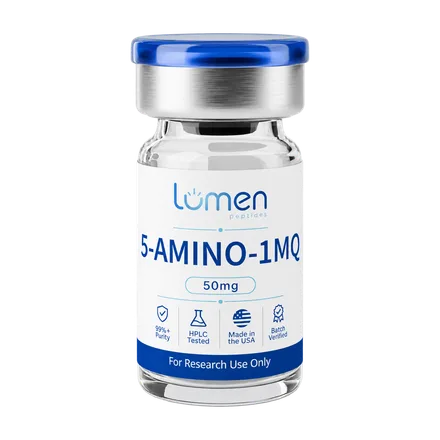
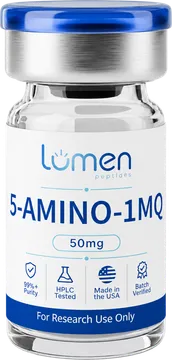
5-AMINO-1MQ
- Molecular weight
- 158.2g/mol
- Formula
- C10H10N2
- CAS number
- 4213-45-0
- Type
- Synthetic peptide
- Form
- Lyophilized powder
- Sizes
- 50mg

Research access
Lumen supplies research compounds to qualified researchers and laboratories for in-vitro use. Confirm once to enter.
By entering you affirm the statement above is true. Products are not for human or veterinary use, not for diagnostic procedures, and have not been evaluated by the FDA.
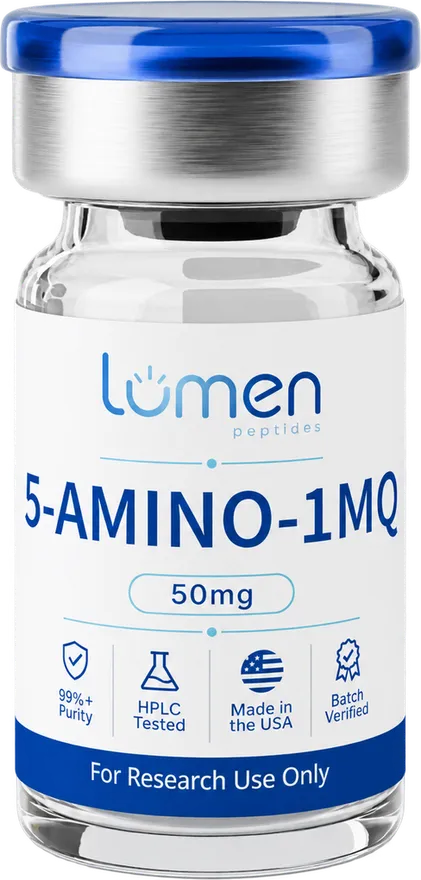
99.91%HPLC purity
Longevity Research
Small-molecule NNMT inhibitor for metabolic research.
$80.0050mg vial
Buy 1, get 1 free: add a 2nd vial and it is free.
Researchers also added
Mix and match: Buy 1, get 1 free pairs any two vials in your cart. Research use only.
The compound
5-Amino-1-methylquinolinium (5-Amino-1MQ) is a small-molecule inhibitor of nicotinamide N-methyltransferase (NNMT), studied in adipocyte-metabolism and NAD-salvage research. Not a peptide. Research use only.
Specification sheet
Where it is studied
Inhibits NNMT - the core mechanism studied in adipocyte-metabolism models.
Investigated for downstream effects on cellular NAD+ pools.
In the lab
5-Amino-1MQ is a small-molecule inhibitor of NNMT, the enzyme that methylates nicotinamide. In laboratory research it lowered the NNMT product 1-MNA and raised NAD+ and SAM in adipocytes, and supported aged muscle stem cell activity.
Compound
5-AMINO-1MQNNMT inhibitor, 5-amino-1-methylquinoliniumCultured adipocytes
Endpoint studied
Lower lipogenesisNNMT inhibitors cut intracellular 1-MNA, raised NAD+ and SAM, and suppressed lipogenesis.Neelakantan 2018 · PMID 29155147 (opens PubMed in a new tab)Muscle stem cells, myoblasts
Endpoint studied
Myofiber regenerationStem cells proliferated and fused more after injury; myoblasts differentiated more, with NAD+/NADH shifts.Neelakantan 2019 · PMID 30753815 (opens PubMed in a new tab)Research history
5 milestones, each linked to its PubMed record.
2017
Journal of Medicinal Chemistry
A structure-activity study identifies methylquinoliniums as NNMT inhibitors near 1 micromolar; docking places them in the nicotinamide site.
PubMed · PMID 28548833 (opens in a new tab)2018
Biochemical Pharmacology
Methylquinolinium inhibitors cross membranes, spare related methyltransferases, and raise NAD+ and SAM in cultured adipocytes.
PubMed · PMID 29155147 (opens in a new tab)2019
Biochemical Pharmacology
In an aged muscle injury model, stem cell activity rose, giving larger myofibers and about 70% higher contractile torque.
PubMed · PMID 30753815 (opens in a new tab)2021
Journal of Pharmaceutical and Biomedical Analysis
An LC-MS/MS assay is validated to measure 5-amino-1MQ in plasma and urine samples.
PubMed · PMID 34304009 (opens in a new tab)2024
Diabetes, Obesity & Metabolism
In an obesity model, 5A1MQ improved glucose tolerance and insulin sensitivity, eased hepatic steatosis, and reached adipose, muscle and liver.
PubMed · PMID 39161060 (opens in a new tab)Laboratory research only, cited for research context. Not a claim about use in people.
Catalog peptides are specified at 99%+ identity purity. Each lot is verified by an independent laboratory using HPLC and mass spectrometry, and the results are published in that lot's Certificate of Analysis.
A COA is the lab document issued for a specific production lot. It records the compound's identity confirmation, measured purity and the lot number, so the vial on the bench can be traced back to its test results.
Orders placed before the daily cutoff ship the same or next business day from a US facility. Lyophilized peptides are stable in transit and do not require cold shipping.
L-H2O is a sterile, USP-grade laboratory solvent containing 0.9% benzyl alcohol. It is a bench accessory, not a peptide, and carries no HPLC purity claim or COA.
Research use only. Sold strictly for in-vitro laboratory research by qualified professionals. Not for human or veterinary use, not for diagnostic or therapeutic procedures, and not evaluated by the FDA.