Specification sheet
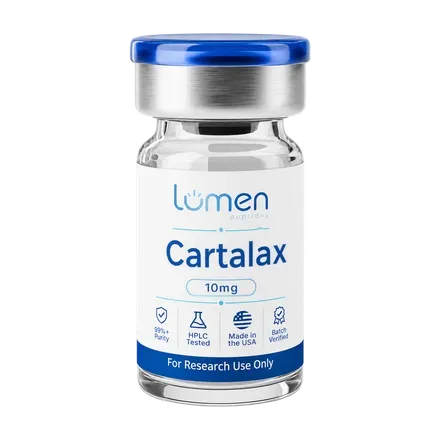
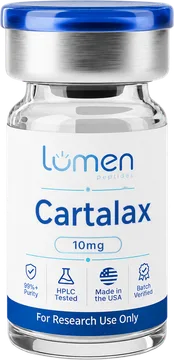
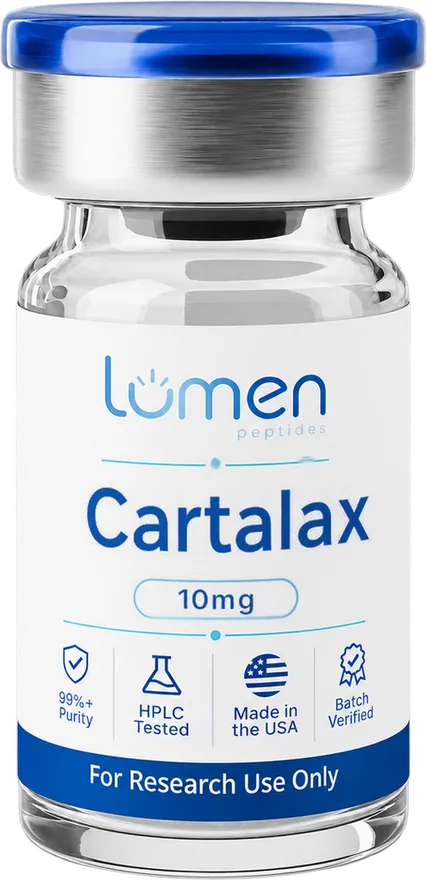
Cartalax
- Molecular weight
- 333.3g/mol
- Formula
- C12H19N3O8
Sequence 3 residues
- Type
- Synthetic peptide
- Form
- Lyophilized powder
- Sizes
- 10mg

Research access
Lumen supplies research compounds to qualified researchers and laboratories for in-vitro use. Confirm once to enter.
By entering you affirm the statement above is true. Products are not for human or veterinary use, not for diagnostic procedures, and have not been evaluated by the FDA.
99.99%HPLC purity
Longevity Research
Short peptide bioregulator studied in cartilage and connective-tissue research.
$75.0010mg vial
Buy 1, get 1 free: add a 2nd vial and it is free.
Researchers also added
Mix and match: Buy 1, get 1 free pairs any two vials in your cart. Research use only.
The compound
Cartalax is a synthetic Ala-Glu-Asp tripeptide bioregulator studied in cartilage, connective-tissue and cellular-aging research models. Research use only.
Specification sheet
Sequence 3 residues
Where it is studied
Investigated for gene-expression effects in chondrocyte and fibroblast models.
Explored as a short-peptide regulator alongside Epithalon and Pinealon.
In the lab
Cartalax is the synthetic tripeptide Ala-Glu-Asp (AED); no receptor for it has been identified. In cell studies it raised sirtuins and collagen I in skin fibroblasts, lowered p16, p21 and p53 in renal cells, and raised cartilage genes in stem cells.
Compound
CartalaxSynthetic Ala-Glu-Asp (AED) tripeptideHuman skin fibroblasts
Endpoint studied
Higher protein synthesisMore sirtuin-1, sirtuin-6 and collagen I synthesis in skin fibroblasts during replicative aging.Fridman 2020 · PMID 33231794 (opens PubMed in a new tab)Renal cell cultures
Endpoint studied
Cell proliferationMore proliferation, less p16, p21 and p53, and more SIRT-6 in young and aged renal cells.Khavinson 2014 · PMID 25946838 (opens PubMed in a new tab)Mesenchymal stem cells
Endpoint studied
Chondrogenic differentiationRaised SOX9, aggrecan, type II collagen and COMP gene expression and protein in aging stem cells.Myakisheva 2023 · PMID 37782646 (opens PubMed in a new tab)Research history
5 milestones, each linked to its PubMed record.
2014
Bulletin of Experimental Biology and Medicine
The short peptide T-31 (AED) activated cell renewal in aging kidney cell cultures, tracked by Ki-67 and p53.
PubMed · PMID 24958378 (opens in a new tab)2016
Bulletin of Experimental Biology and Medicine
AED lowered MMP-9, raised Ki-67 and CD98hc, and suppressed caspase-dependent apoptosis in aging skin fibroblasts.
PubMed · PMID 27259496 (opens in a new tab)2020
Molecular Biology Reports
In aging mesenchymal stem cell cultures, AED, KED and KE raised NF-kB gene expression, and the peptides raised IGF1.
PubMed · PMID 32399807 (opens in a new tab)2023
Advances in Gerontology = Uspekhi Gerontologii
AED normalized the aging-linked secretory profile of chondrocytes: p16, p21, p53, TNF-alpha, IL-1alpha and Sirt1.
PubMed · PMID 37356100 (opens in a new tab)2023
Advances in Gerontology = Uspekhi Gerontologii
AED raised SOX9, aggrecan, type II collagen and COMP gene expression and protein in aging mesenchymal stem cells.
PubMed · PMID 37782646 (opens in a new tab)Laboratory research only, cited for research context. Not a claim about use in people.
Catalog peptides are specified at 99%+ identity purity. Each lot is verified by an independent laboratory using HPLC and mass spectrometry, and the results are published in that lot's Certificate of Analysis.
A COA is the lab document issued for a specific production lot. It records the compound's identity confirmation, measured purity and the lot number, so the vial on the bench can be traced back to its test results.
Orders placed before the daily cutoff ship the same or next business day from a US facility. Lyophilized peptides are stable in transit and do not require cold shipping.
L-H2O is a sterile, USP-grade laboratory solvent containing 0.9% benzyl alcohol. It is a bench accessory, not a peptide, and carries no HPLC purity claim or COA.
Research use only. Sold strictly for in-vitro laboratory research by qualified professionals. Not for human or veterinary use, not for diagnostic or therapeutic procedures, and not evaluated by the FDA.