Specification sheet
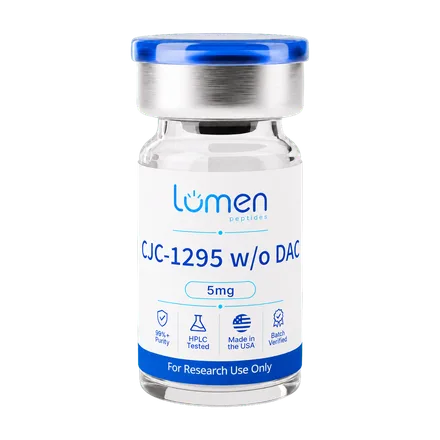
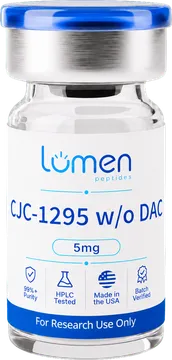
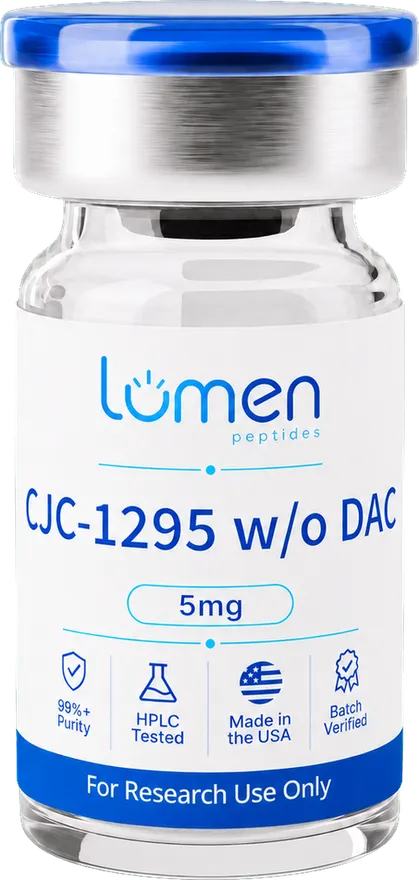
CJC-1295 w/o DAC
- Molecular weight
- 3367.9g/mol
- Formula
- C152H252N44O42
- CAS number
- 863288-34-0
- Type
- Synthetic peptide
- Form
- Lyophilized powder
- Sizes
- 5mg

Research access
Lumen supplies research compounds to qualified researchers and laboratories for in-vitro use. Confirm once to enter.
By entering you affirm the statement above is true. Products are not for human or veterinary use, not for diagnostic procedures, and have not been evaluated by the FDA.
99.72%HPLC purity
Secretagogue Research
GHRH-analog secretagogue research peptide.
$45.005mg vial
Buy 1, get 1 free: add a 2nd vial and it is free.
Researchers also added
Mix and match: Buy 1, get 1 free pairs any two vials in your cart. Research use only.
The compound
CJC-1295 (without DAC) is a growth-hormone-releasing hormone analog studied in GH-axis secretagogue research. Research use only.
Specification sheet
Where it is studied
Agonism at the GHRH receptor drives GH-release signaling in preclinical models.
Frequently co-studied with ghrelin-receptor agonists in comparative research.
The no-DAC variant has a short half-life studied in PK models.
In the lab
CJC-1295 without DAC is a tetrasubstituted GRF(1-29); lab papers on this exact form are scarce, so those cited studied GRF(1-29) analogs. Such analogs act on the pituitary GRF receptor and adenylate cyclase, and D-residues at the cleavage site block DPP IV.
Compound
CJC-1295 w/o DACModified GRF(1-29), no DAC; papers: GRF(1-29) analogsPituitary membranes
Endpoint studied
Cyclase activationIn 30 GRF(1-29) analogs, the C-terminal part set receptor recognition, the N-terminal part cyclase activation.Robberecht 1986 · PMID 3018703 (opens PubMed in a new tab)Pituitary cells
Endpoint studied
GH release[Ala15]GRH(1-29) was 5x as potent as [Gly15]; D-Ala2, Ala8 and Ala15 together gave a 27-fold gain.Coy 1991 · PMID 1806385 (opens PubMed in a new tab)Human placental DPP IV
Endpoint studied
Cleavage blockedDPP IV cut GRF(1-29) at Ala2-Asp3; analogs with a D-residue at the cleavage site were not cleaved.Bongers 1992 · PMID 1353684 (opens PubMed in a new tab)Research history
4 milestones, each linked to its PubMed record.
1984
Biochemical and Biophysical Research Communications
[D-Ala2]-GRF(1-29)-NH2 releases GH about 50 times more potently than the parent peptide in laboratory models.
PubMed · PMID 6231028 (opens in a new tab)1986
Peptides
Thirty GRF(1-29) analogs are tested on pituitary GRF receptors and adenylate cyclase in membrane preparations.
PubMed · PMID 3018703 (opens in a new tab)1991
European Journal of Pharmacology
Helix-favoring Ala8 and Ala15 substitutions, with D-Ala2, raise GH release potency in pituitary cells additively.
PubMed · PMID 1806385 (opens in a new tab)1992
Biochimica et Biophysica Acta
Purified DPP IV cuts GRF(1-29) at Ala2-Asp3, while analogs with D-residues at the cleavage site resist it.
PubMed · PMID 1353684 (opens in a new tab)Laboratory research only, cited for research context. Not a claim about use in people.
Catalog peptides are specified at 99%+ identity purity. Each lot is verified by an independent laboratory using HPLC and mass spectrometry, and the results are published in that lot's Certificate of Analysis.
A COA is the lab document issued for a specific production lot. It records the compound's identity confirmation, measured purity and the lot number, so the vial on the bench can be traced back to its test results.
Orders placed before the daily cutoff ship the same or next business day from a US facility. Lyophilized peptides are stable in transit and do not require cold shipping.
L-H2O is a sterile, USP-grade laboratory solvent containing 0.9% benzyl alcohol. It is a bench accessory, not a peptide, and carries no HPLC purity claim or COA.
Research use only. Sold strictly for in-vitro laboratory research by qualified professionals. Not for human or veterinary use, not for diagnostic or therapeutic procedures, and not evaluated by the FDA.