Specification sheet
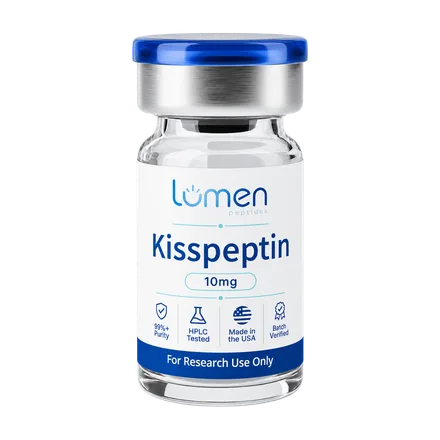
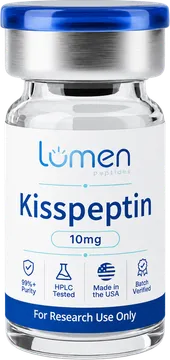
Kisspeptin-10
- Molecular weight
- 1302.5g/mol
- Formula
- C63H83N17O14
- CAS number
- 374675-21-5
Sequence
YNWNSFGLRF-NH2
- Type
- Synthetic peptide
- Form
- Lyophilized powder
- Sizes
- 10mg

Research access
Lumen supplies research compounds to qualified researchers and laboratories for in-vitro use. Confirm once to enter.
By entering you affirm the statement above is true. Products are not for human or veterinary use, not for diagnostic procedures, and have not been evaluated by the FDA.
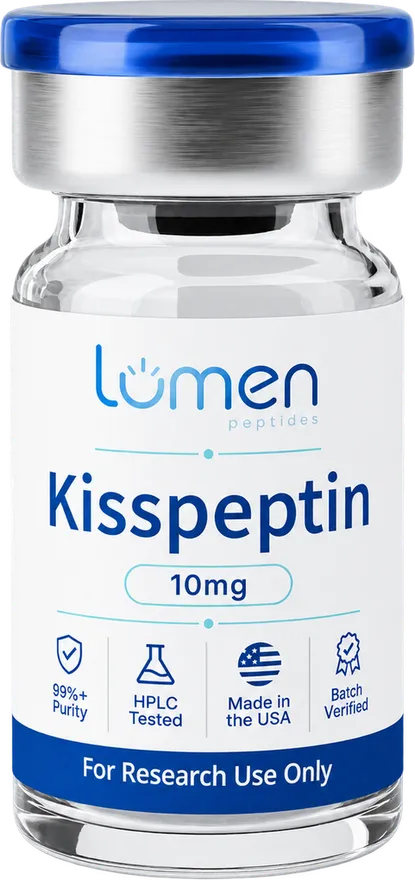
99.08%HPLC purity
Cognitive / Neuro Research
GnRH-axis signaling decapeptide for neuroendocrine research.
$70.0010mg vial
Buy 1, get 1 free: add a 2nd vial and it is free.
Researchers also added
Mix and match: Buy 1, get 1 free pairs any two vials in your cart. Research use only.
The compound
Kisspeptin-10 is the active decapeptide of the KISS1 gene product, studied in reproductive-neuroendocrine and GnRH-axis research models. Research use only.
Specification sheet
Sequence
YNWNSFGLRF-NH2
Where it is studied
Agonism at the KISS1 receptor upstream of GnRH is the core mechanism studied.
Investigated for downstream gonadotropin signaling in preclinical models.
In the lab
Kisspeptin-10 is a decapeptide from the KISS1 gene product that activates the G protein-coupled receptor GPR54. In laboratory research it drives PLC-linked calcium signaling in GnRH-1 neurons and slows trophoblast cell migration through GSK3 beta and FAK.
Compound
Kisspeptin-10Decapeptide from the KISS1 gene product, a GPR54 ligandGnRH-1 neurons
Endpoint studied
Calcium oscillationsStarted calcium oscillations in quiet GnRH-1 neurons and raised spike frequency in active ones.Constantin 2009 · PMID 18948403 (opens PubMed in a new tab)Trophoblast cell line
Endpoint studied
Less cell migrationMigration fell, maximal at 100 nM, as GSK3 beta Ser9 and FAK Tyr925 phosphorylation each rose 3-fold.Roseweir 2012 · PMID 22349353 (opens PubMed in a new tab)Osteoclasts
Endpoint studied
Lower osteoclast activityBinding to GPR54 raised Dusp18, which dephosphorylated Src at Tyr416 and reduced osteoclast activity.Li 2024 · PMID 38346942 (opens PubMed in a new tab)Research history
5 milestones, each linked to its PubMed record.
2004
Journal of Cell Science
Kp-10 is identified in first-trimester human trophoblast medium; it raised calcium and slowed trophoblast migration without changing proliferation.
PubMed · PMID 15020672 (opens in a new tab)2004
Journal of Neuroendocrinology
Raised LH, FSH and testosterone and released LHRH from hypothalamic explants, with no direct effect on pituitary fragments.
PubMed · PMID 15500545 (opens in a new tab)2009
Endocrinology
Through GPR54 and phospholipase C, it facilitates a plasma membrane calcium oscillator in GnRH-1 neurons.
PubMed · PMID 18948403 (opens in a new tab)2012
Placenta
In a trophoblast cell line, it slows migration through an ERK1/2, p90rsk, GSK3 beta and FAK feedback loop.
PubMed · PMID 22349353 (opens in a new tab)2024
Nature Communications
Binding to GPR54 raises Dusp18, which dephosphorylates Src at Tyr416 and suppresses osteoclast activity.
PubMed · PMID 38346942 (opens in a new tab)Laboratory research only, cited for research context. Not a claim about use in people.
Catalog peptides are specified at 99%+ identity purity. Each lot is verified by an independent laboratory using HPLC and mass spectrometry, and the results are published in that lot's Certificate of Analysis.
A COA is the lab document issued for a specific production lot. It records the compound's identity confirmation, measured purity and the lot number, so the vial on the bench can be traced back to its test results.
Orders placed before the daily cutoff ship the same or next business day from a US facility. Lyophilized peptides are stable in transit and do not require cold shipping.
L-H2O is a sterile, USP-grade laboratory solvent containing 0.9% benzyl alcohol. It is a bench accessory, not a peptide, and carries no HPLC purity claim or COA.
Research use only. Sold strictly for in-vitro laboratory research by qualified professionals. Not for human or veterinary use, not for diagnostic or therapeutic procedures, and not evaluated by the FDA.