Specification sheet
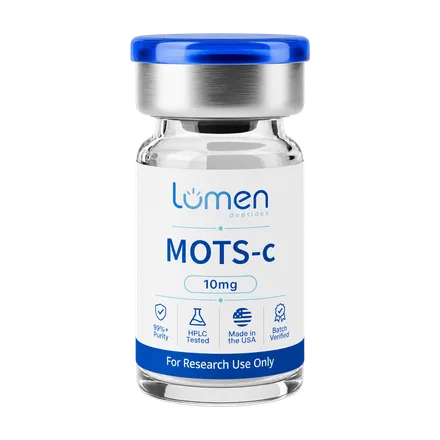
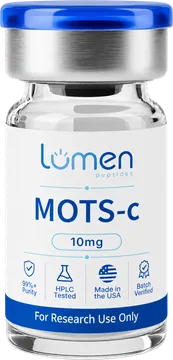
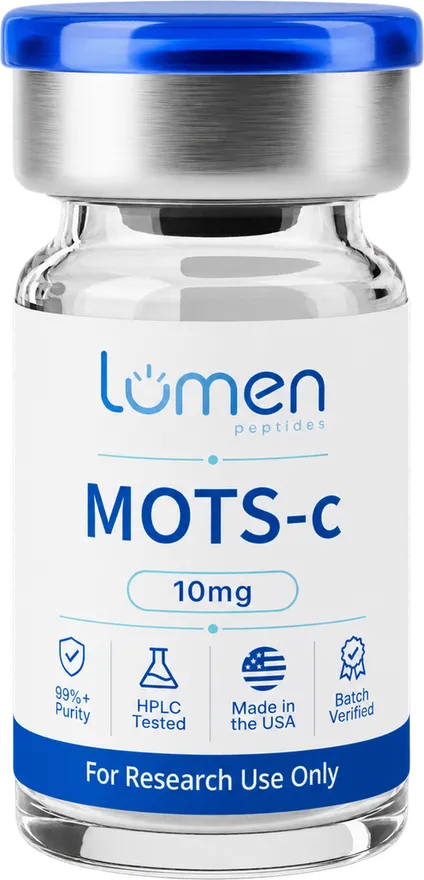
MOTS-c
- Molecular weight
- 2174.6g/mol
- Formula
- C101H152N28O22S2
- CAS number
- 1627580-64-6
Sequence 16 residues
- Type
- Synthetic peptide
- Form
- Lyophilized powder
- Sizes
- 10mg

Research access
Lumen supplies research compounds to qualified researchers and laboratories for in-vitro use. Confirm once to enter.
By entering you affirm the statement above is true. Products are not for human or veterinary use, not for diagnostic procedures, and have not been evaluated by the FDA.
99.86%HPLC purity
Longevity Research
Mitochondrial-signal longevity research peptide.
$55.0010mg vial
Buy 1, get 1 free: add a 2nd vial and it is free.
Researchers also added
Mix and match: Buy 1, get 1 free pairs any two vials in your cart. Research use only.
The compound
MOTS-c is a mitochondrial-derived peptide studied in metabolic-homeostasis and cellular-aging models. Research use only.
Specification sheet
Sequence 16 residues
Where it is studied
Investigated for AMPK-activation signaling in metabolic models.
Explored for mitochondrial-function endpoints in cellular models.
Studied in glucose-regulation models. Illustrative only.
In the lab
MOTS-c is a 16-amino-acid peptide encoded within the mitochondrial 12S rRNA gene. In laboratory research it inhibits the folate cycle to activate AMPK, and under metabolic stress it moves into the nucleus to regulate stress-response genes.
Compound
MOTS-c16-amino-acid peptide from mitochondrial 12S rRNASkeletal muscle
Endpoint studied
Insulin sensitivityInhibited the folate cycle and de novo purine synthesis, leading to AMPK activation.Lee 2015 · PMID 25738459 (opens PubMed in a new tab)Glucose-restricted cells
Endpoint studied
Nuclear gene expressionMoved into the nucleus after glucose restriction, AMPK-dependent, and interacted with NRF2 at ARE genes.Kim 2018 · PMID 29983246 (opens PubMed in a new tab)Mammalian cells
Endpoint studied
Glucose uptakeRaised fusion proteins OPA1 and MFN2; blocking them or MFN2 knockdown stopped GLUT4 translocation.Bhullar 2021 · PMID 34253808 (opens PubMed in a new tab)Research history
4 milestones, each linked to its PubMed record.
2015
Cell Metabolism
A 16-amino-acid peptide encoded in the mitochondrial 12S rRNA is reported, acting on the folate cycle and AMPK.
PubMed · PMID 25738459 (opens in a new tab)2016
Biochemical and Biophysical Research Communications
Less bone loss in a bone loss model, with RANKL-induced osteoclast formation inhibited partly through AMPK.
PubMed · PMID 27237975 (opens in a new tab)2018
Cell Metabolism
Under metabolic stress MOTS-c moves to the nucleus, AMPK-dependent, regulating ARE genes and interacting with NRF2.
PubMed · PMID 29983246 (opens in a new tab)2021
Scientific Reports
Fusion proteins OPA1 and MFN2 are needed for MOTS-c-induced GLUT4 translocation and glucose uptake in cells.
PubMed · PMID 34253808 (opens in a new tab)Laboratory research only, cited for research context. Not a claim about use in people.
Catalog peptides are specified at 99%+ identity purity. Each lot is verified by an independent laboratory using HPLC and mass spectrometry, and the results are published in that lot's Certificate of Analysis.
A COA is the lab document issued for a specific production lot. It records the compound's identity confirmation, measured purity and the lot number, so the vial on the bench can be traced back to its test results.
Orders placed before the daily cutoff ship the same or next business day from a US facility. Lyophilized peptides are stable in transit and do not require cold shipping.
L-H2O is a sterile, USP-grade laboratory solvent containing 0.9% benzyl alcohol. It is a bench accessory, not a peptide, and carries no HPLC purity claim or COA.
Research use only. Sold strictly for in-vitro laboratory research by qualified professionals. Not for human or veterinary use, not for diagnostic or therapeutic procedures, and not evaluated by the FDA.