Specification sheet
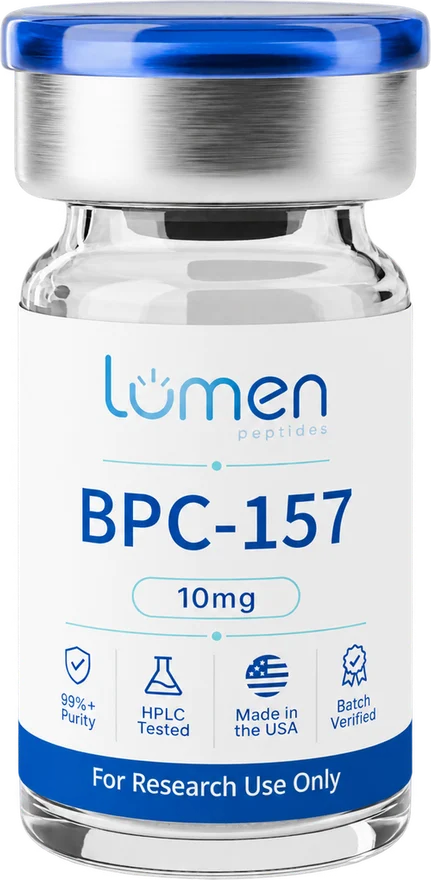
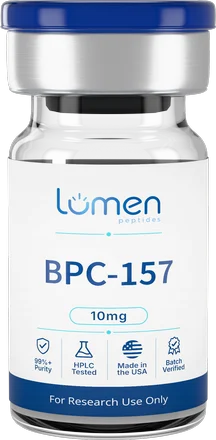
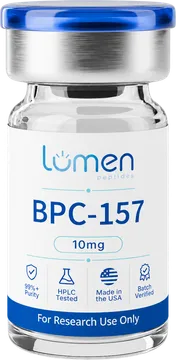
BPC-157
- Molecular weight
- 1419.5g/mol
- Formula
- C62H98N16O22
- CAS number
- 137525-51-0
Sequence 15 residues
- Type
- Synthetic peptide
- Form
- Lyophilized powder
- Sizes
- 10mg

Research access
Lumen supplies research compounds to qualified researchers and laboratories for in-vitro use. Confirm once to enter.
By entering you affirm the statement above is true. Products are not for human or veterinary use, not for diagnostic procedures, and have not been evaluated by the FDA.
99.86%HPLC purity
Cytoprotection Research
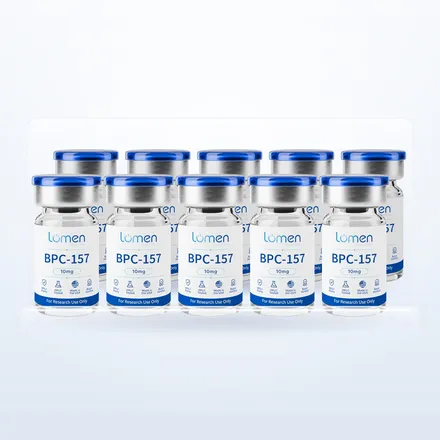
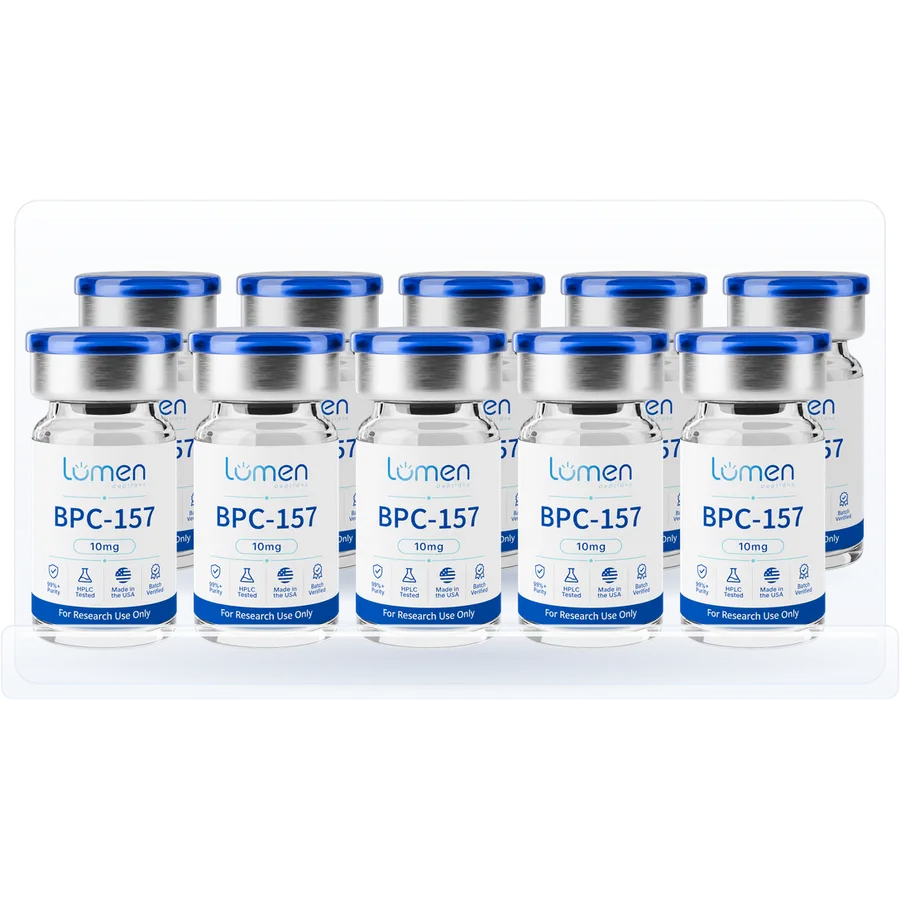
Ten BPC-157 vials in one case.
$220.0010 × 10mg vials
Ten vials in one case, $22.00 per vial.
Researchers also added
Mix and match: Buy 1, get 1 free pairs any two vials in your cart. Research use only.
The compound
BPC-157 is a stable synthetic pentadecapeptide derived from a sequence in human gastric juice. It is one of the most-cited cytoprotection and tissue-repair research peptides, studied across angiogenesis, tendon-fibroblast and gut-protection models.
Specification sheet
Sequence 15 residues
Where it is studied
Studied for effects on new-vessel formation markers in wound-healing models.
Investigated for gastrointestinal cytoprotective signaling in laboratory models.
Explored in connective-tissue repair endpoints. Illustrative only.
In the lab
No single receptor for BPC-157 has been identified. In laboratory research it is reported to switch on repair signaling: the VEGFR2-Akt-eNOS pathway in blood-vessel cells, and FAK-paxillin in tendon fibroblasts.
Compound
BPC-15715-amino-acid fragment of BPC, a gastric juice peptideEndothelial cells
Endpoint studied
New vessel formationHigher vessel density, more endothelial tube formation and faster blood-flow recovery.Hsieh 2017 · PMID 27847966 (opens PubMed in a new tab)Tendon fibroblasts
Endpoint studied
Fibroblast migrationFaster outgrowth from tendon explants, more cell spreading, better survival under oxidative stress.Chang 2011 · PMID 21030672 (opens PubMed in a new tab)Tendon fibroblasts
Endpoint studied
Growth-signal responseMore growth hormone receptor; added growth hormone then raised fibroblast proliferation.Chang 2014 · PMID 25415472 (opens PubMed in a new tab)Research history
5 milestones, each linked to its PubMed record.
1993
Journal of Physiology, Paris
A protective peptide isolated from human gastric juice is reported, with BPC 157, the 15-amino-acid fragment thought to carry its activity.
PubMed · PMID 8298609 (opens in a new tab)2003
Journal of Orthopaedic Research
Transected Achilles tendons heal faster in a repair model, and tendon cells grow more in culture.
PubMed · PMID 14554208 (opens in a new tab)2011
Journal of Applied Physiology
Tendon fibroblasts migrate and spread more, with FAK and paxillin activated.
PubMed · PMID 21030672 (opens in a new tab)2017
Journal of Molecular Medicine
VEGFR2 rises and VEGFR2-Akt-eNOS signaling switches on in endothelial cells, alongside faster blood-flow recovery in an ischemia model.
PubMed · PMID 27847966 (opens in a new tab)2018
Current Pharmaceutical Design
A review compares BPC 157 with EGF, FGF and VEGF across gut, tendon, ligament, muscle and bone healing research.
PubMed · PMID 29998800 (opens in a new tab)Laboratory research only, cited for research context. Not a claim about use in people.
Catalog peptides are specified at 99%+ identity purity. Each lot is verified by an independent laboratory using HPLC and mass spectrometry, and the results are published in that lot's Certificate of Analysis.
A COA is the lab document issued for a specific production lot. It records the compound's identity confirmation, measured purity and the lot number, so the vial on the bench can be traced back to its test results.
Orders placed before the daily cutoff ship the same or next business day from a US facility. Lyophilized peptides are stable in transit and do not require cold shipping.
L-H2O is a sterile, USP-grade laboratory solvent containing 0.9% benzyl alcohol. It is a bench accessory, not a peptide, and carries no HPLC purity claim or COA.
Research use only. Sold strictly for in-vitro laboratory research by qualified professionals. Not for human or veterinary use, not for diagnostic or therapeutic procedures, and not evaluated by the FDA.