Specification sheet
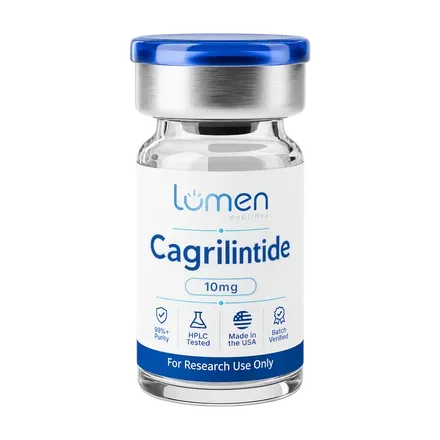
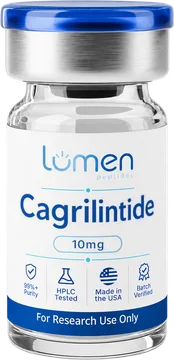
Cagrilintide
- Molecular weight
- 4409.0g/mol
- Formula
- C194H312N54O59S2
- CAS number
- 1415456-99-3
- Type
- Synthetic peptide
- Form
- Lyophilized powder
- Sizes
- 10mg

Research access
Lumen supplies research compounds to qualified researchers and laboratories for in-vitro use. Confirm once to enter.
By entering you affirm the statement above is true. Products are not for human or veterinary use, not for diagnostic procedures, and have not been evaluated by the FDA.
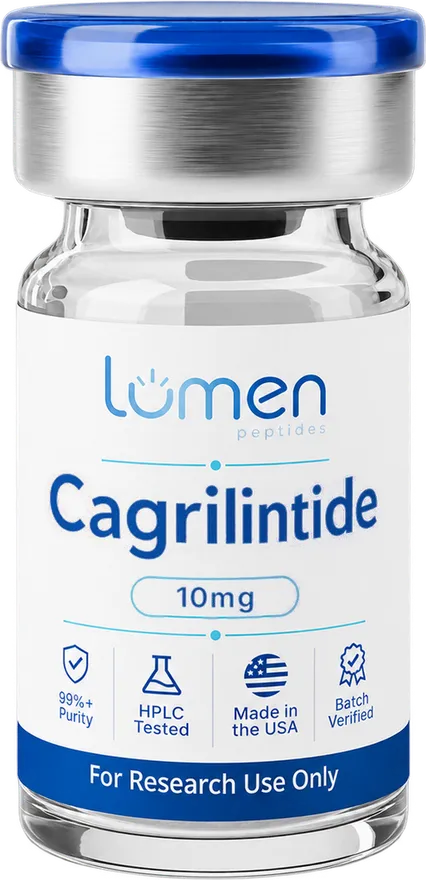
99.7%HPLC purity
Metabolic / GLP-1 Research
Long-acting amylin analog studied in appetite and metabolic research.
$90.0010mg vial
Buy 1, get 1 free: add a 2nd vial and it is free.
Researchers also added
Mix and match: Buy 1, get 1 free pairs any two vials in your cart. Research use only.
The compound
Cagrilintide is a long-acting, acylated analog of the pancreatic hormone amylin, studied in appetite-regulation and metabolic research models, alone and alongside GLP-1 receptor agonists. Research use only.
Specification sheet
Where it is studied
Agonism at amylin (calcitonin-family) receptors is the core mechanism studied.
Investigated for central satiety and gastric-emptying signaling in preclinical models.
In the lab
Cagrilintide is a lipidated, long-acting amylin analog that activates amylin receptors and the calcitonin receptor through Gs. In laboratory models its energy-balance effects depend on brain amylin receptors and on Calcr/Prlh brainstem neurons.
Compound
CagrilintideLong-acting acylated amylin analogReceptor-Gs complexes
Endpoint studied
Gs signalingCryo-EM structures show one bypass binding mode at both receptors and non-selective Gs activation.Gu 2026 · PMID 40847076 (opens PubMed in a new tab)Brainstem neurons
Endpoint studied
Neuron activationWithout RAMP1 and RAMP3 its potency fell and its area postrema c-Fos signal dropped 57%.Carvas 2025 · PMID 40609154 (opens PubMed in a new tab)Dorsal vagal complex
Endpoint studied
Energy-balance effectsLonger exposure raised Prlh in Calcr/Prlh neurons; knocking down Prlh blocked its effects.Ludwig 2026 · PMID 42260119 (opens PubMed in a new tab)Research history
5 milestones, each linked to its PubMed record.
2021
The Journal of Pharmacology and Experimental Therapeutics
AM833 (cagrilintide), a lipidated amylin analog, is profiled across 25 endpoints as a nonselective amylin and calcitonin receptor agonist.
PubMed · PMID 33727283 (opens in a new tab)2021
Journal of Medicinal Chemistry
Structure-activity work on amylin, a hormone prone to forming fibrils, leads to cagrilintide, a stable, lipidated long-acting analog.
PubMed · PMID 34288673 (opens in a new tab)2025
Nature Communications
Cryo-EM structures at AMY1R, AMY2R, AMY3R and CTR show an amylin-like binding mode with distinct receptor dynamics.
PubMed · PMID 40204768 (opens in a new tab)2025
EBioMedicine
In an obesity model its effects depended on amylin receptors 1 and 3, with c-Fos activation in brainstem neurons.
PubMed · PMID 40609154 (opens in a new tab)2026
Nature Metabolism
An atlas of over 530,000 brainstem cells across species points to Calcr/Prlh neurons as mediators of its effects.
PubMed · PMID 42260119 (opens in a new tab)Laboratory research only, cited for research context. Not a claim about use in people.
Catalog peptides are specified at 99%+ identity purity. Each lot is verified by an independent laboratory using HPLC and mass spectrometry, and the results are published in that lot's Certificate of Analysis.
A COA is the lab document issued for a specific production lot. It records the compound's identity confirmation, measured purity and the lot number, so the vial on the bench can be traced back to its test results.
Orders placed before the daily cutoff ship the same or next business day from a US facility. Lyophilized peptides are stable in transit and do not require cold shipping.
L-H2O is a sterile, USP-grade laboratory solvent containing 0.9% benzyl alcohol. It is a bench accessory, not a peptide, and carries no HPLC purity claim or COA.
Research use only. Sold strictly for in-vitro laboratory research by qualified professionals. Not for human or veterinary use, not for diagnostic or therapeutic procedures, and not evaluated by the FDA.