Specification sheet
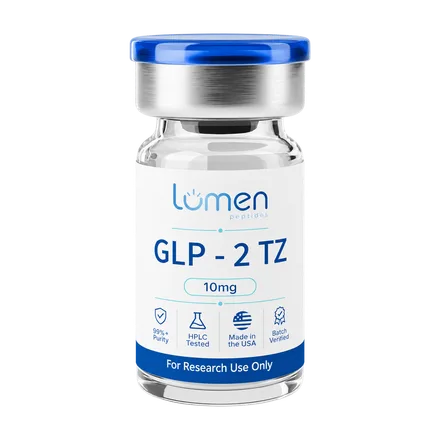
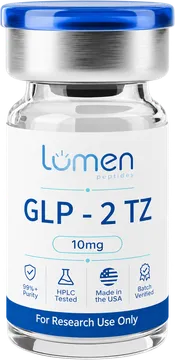
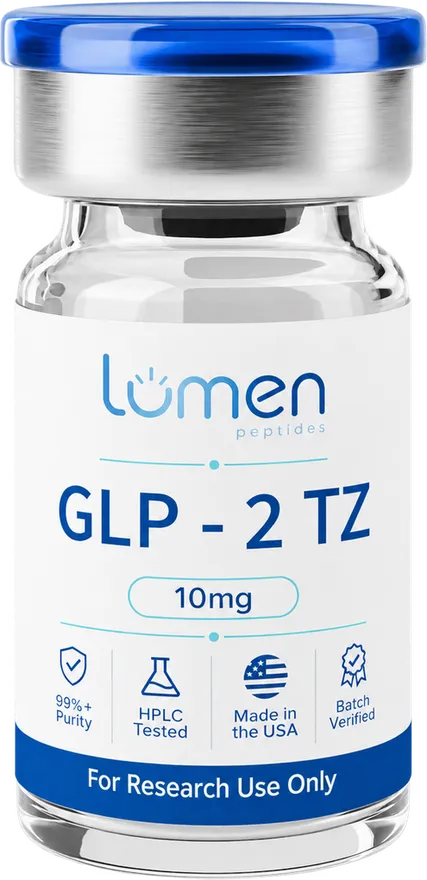
GLP-2 TZ
- Molecular weight
- 4813.5g/mol
- Formula
- C225H348N48O68
- CAS number
- 2023788-19-2
Sequence 39 residues
- Type
- Synthetic peptide
- Form
- Lyophilized powder
- Sizes
- 10mg · 30mg · 60mg · 100mg

Research access
Lumen supplies research compounds to qualified researchers and laboratories for in-vitro use. Confirm once to enter.
By entering you affirm the statement above is true. Products are not for human or veterinary use, not for diagnostic procedures, and have not been evaluated by the FDA.
99.9%HPLC purity
Metabolic / GLP-1 Research
Dual-incretin research peptide, documented lot-by-lot.
$70.0010mg vial
Buy 1, get 1 free: add a 2nd vial and it is free.
Researchers also added
Mix and match: Buy 1, get 1 free pairs any two vials in your cart. Research use only.
The compound
GLP-2 TZ is a 39-amino-acid synthetic peptide engineered as a dual agonist of the GIP and GLP-1 incretin receptors. Its fatty-acid moiety extends half-life for once-weekly PK profiles in the models it is studied in. It is one of the most-referenced dual-incretin research compounds and is supplied here as a documented, third-party-verified lyophilate for in-vitro research.
Specification sheet
Sequence 39 residues
Where it is studied
Agonism at the GLP-1 receptor is studied for its effects on insulinotropic signaling in preclinical models.
Concurrent GIP receptor activity distinguishes this dual agonist in comparative receptor studies.
Investigated in laboratory models of energy intake and adiposity. Not a human efficacy claim.
In the lab
GLP-2 TZ is one acylated peptide that activates both the GIP and GLP-1 receptors. In cell studies it acts like native GIP at the GIP receptor, but at the GLP-1 receptor it favors cAMP over beta-arrestin, with less receptor internalization.
Compound
GLP-2 TZAcylated dual GIP and GLP-1 receptor agonist peptideReceptor cells and islets
Endpoint studied
Insulin responseFavored cAMP over beta-arrestin at GLP-1R; beta-arrestin1 did not limit its insulin response in islets.Willard 2020 · PMID 32730231 (opens PubMed in a new tab)White adipose tissue
Endpoint studied
Glucose disposalRaised insulin sensitivity via glucose disposal in white fat, even without GLP-1R; circulating BCAAs fell.Samms 2021 · PMID 34003802 (opens PubMed in a new tab)Brown adipose tissue
Endpoint studied
Thermogenic-like profileTracer studies: more BCAA and BCKA breakdown in brown fat, with higher alpha-ketoglutarate and malate.Samms 2022 · PMID 35921984 (opens PubMed in a new tab)Research history
4 milestones, each linked to its PubMed record.
2020
JCI Insight
Engages the GIP receptor more than the GLP-1 receptor; at GLP-1R it favors cAMP over beta-arrestin recruitment.
PubMed · PMID 32730231 (opens in a new tab)2021
The Journal of Clinical Investigation
In an obesity model lacking GLP-1R, it still raised insulin sensitivity through glucose disposal in white adipose tissue.
PubMed · PMID 34003802 (opens in a new tab)2022
Proceedings of the National Academy of Sciences of the United States of America
Cryo-EM and simulations show how its fatty acid and sequence set its action: GIP-like at GIPR, distinct at GLP-1R.
PubMed · PMID 35333651 (opens in a new tab)2022
Molecular Metabolism
It stimulated BCAA and BCKA catabolism in brown adipose tissue and raised several TCA cycle intermediates.
PubMed · PMID 35921984 (opens in a new tab)Laboratory research only, cited for research context. Not a claim about use in people.
Catalog peptides are specified at 99%+ identity purity. Each lot is verified by an independent laboratory using HPLC and mass spectrometry, and the results are published in that lot's Certificate of Analysis.
A COA is the lab document issued for a specific production lot. It records the compound's identity confirmation, measured purity and the lot number, so the vial on the bench can be traced back to its test results.
Orders placed before the daily cutoff ship the same or next business day from a US facility. Lyophilized peptides are stable in transit and do not require cold shipping.
L-H2O is a sterile, USP-grade laboratory solvent containing 0.9% benzyl alcohol. It is a bench accessory, not a peptide, and carries no HPLC purity claim or COA.
Research use only. Sold strictly for in-vitro laboratory research by qualified professionals. Not for human or veterinary use, not for diagnostic or therapeutic procedures, and not evaluated by the FDA.