Specification sheet
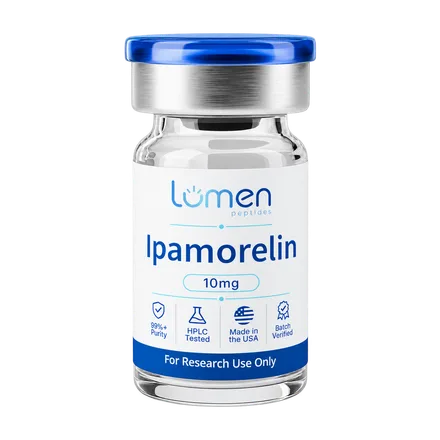
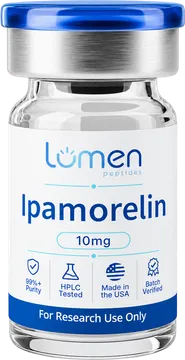
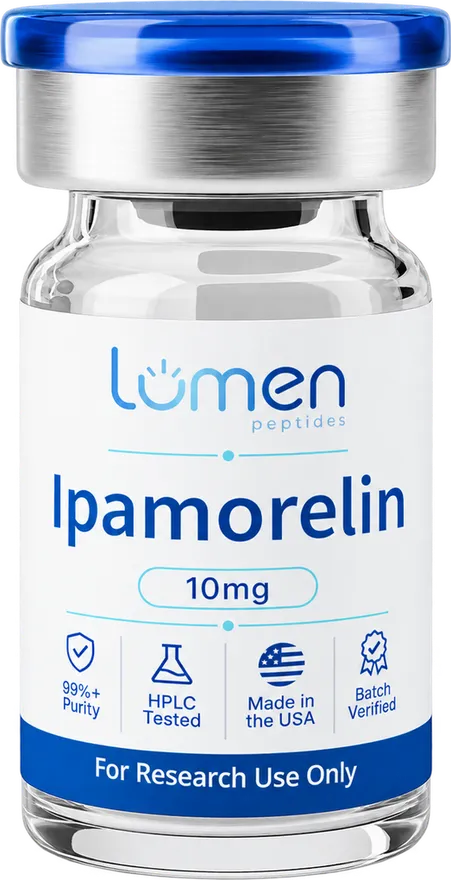
Ipamorelin
- Molecular weight
- 711.9g/mol
- Formula
- C38H49N9O5
- CAS number
- 170851-70-4
Sequence
Aib-His-D-2-Nal-D-Phe-Lys-NH2
- Type
- Synthetic peptide
- Form
- Lyophilized powder
- Sizes
- 10mg

Research access
Lumen supplies research compounds to qualified researchers and laboratories for in-vitro use. Confirm once to enter.
By entering you affirm the statement above is true. Products are not for human or veterinary use, not for diagnostic procedures, and have not been evaluated by the FDA.
99.51%HPLC purity
Secretagogue Research
Selective ghrelin-receptor research peptide.
$65.0010mg vial
Buy 1, get 1 free: add a 2nd vial and it is free.
Researchers also added
Mix and match: Buy 1, get 1 free pairs any two vials in your cart. Research use only.
The compound
Ipamorelin is a selective growth-hormone secretagogue and ghrelin-receptor agonist studied in GH-axis models. Research use only.
Specification sheet
Sequence
Aib-His-D-2-Nal-D-Phe-Lys-NH2
Where it is studied
Selective GHS-R1a agonism drives GH-release signaling in preclinical models.
Studied for pulsatile GH-release patterns in laboratory models.
Low cortisol/prolactin cross-activity is a common selectivity study point.
In the lab
Ipamorelin is a five-residue peptide that releases growth hormone through the GHRP receptor, also described as the ghrelin receptor. In laboratory models its GH release was selective, without the ACTH and cortisol rise seen with GHRP-6 and GHRP-2.
Compound
IpamorelinSynthetic pentapeptide, Aib-His-D-2-Nal-D-Phe-Lys-NH2Pituitary cells
Endpoint studied
GH releaseReleased GH from pituitary cells as potently as GHRP-6; ACTH and cortisol did not rise in laboratory models.Raun 1998 · PMID 9849822 (opens PubMed in a new tab)Gastric smooth muscle
Endpoint studied
Faster gastric emptyingRestored acetylcholine- and nerve-driven contraction of gastric muscle in an ileus model; emptying sped up.Greenwood-Van Meerveld 2012 · PMID 27186127 (opens PubMed in a new tab)Pancreatic tissue
Endpoint studied
Insulin secretionMore insulin release from normal and diabetic pancreatic tissue; calcium channel or adrenergic blocks cut it.Adeghate 2004 · PMID 15665799 (opens PubMed in a new tab)Research history
5 milestones, each linked to its PubMed record.
1998
European Journal of Endocrinology
A pentapeptide from a GHRP-1 chemistry program releases GH like GHRP-6 but leaves ACTH and cortisol unchanged.
PubMed · PMID 9849822 (opens in a new tab)1999
Growth Hormone & IGF Research
Raised the longitudinal bone growth rate in a growth model, with total IGF-I unchanged.
PubMed · PMID 10373343 (opens in a new tab)2000
The Journal of Endocrinology
Raised bone mineral content in a long-term model through larger bone dimensions, not denser bone.
PubMed · PMID 10828840 (opens in a new tab)2004
Neuro Endocrinology Letters
Pancreatic tissue fragments release more insulin, through calcium channel and adrenergic receptor pathways.
PubMed · PMID 15665799 (opens in a new tab)2012
Journal of Experimental Pharmacology
Gastric emptying sped up in an ileus model, via a ghrelin receptor mechanism involving cholinergic neurons.
PubMed · PMID 27186127 (opens in a new tab)Laboratory research only, cited for research context. Not a claim about use in people.
Catalog peptides are specified at 99%+ identity purity. Each lot is verified by an independent laboratory using HPLC and mass spectrometry, and the results are published in that lot's Certificate of Analysis.
A COA is the lab document issued for a specific production lot. It records the compound's identity confirmation, measured purity and the lot number, so the vial on the bench can be traced back to its test results.
Orders placed before the daily cutoff ship the same or next business day from a US facility. Lyophilized peptides are stable in transit and do not require cold shipping.
L-H2O is a sterile, USP-grade laboratory solvent containing 0.9% benzyl alcohol. It is a bench accessory, not a peptide, and carries no HPLC purity claim or COA.
Research use only. Sold strictly for in-vitro laboratory research by qualified professionals. Not for human or veterinary use, not for diagnostic or therapeutic procedures, and not evaluated by the FDA.