Specification sheet
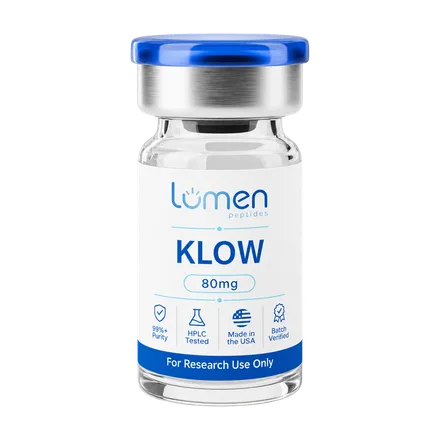
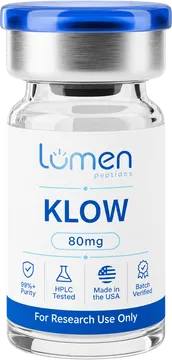
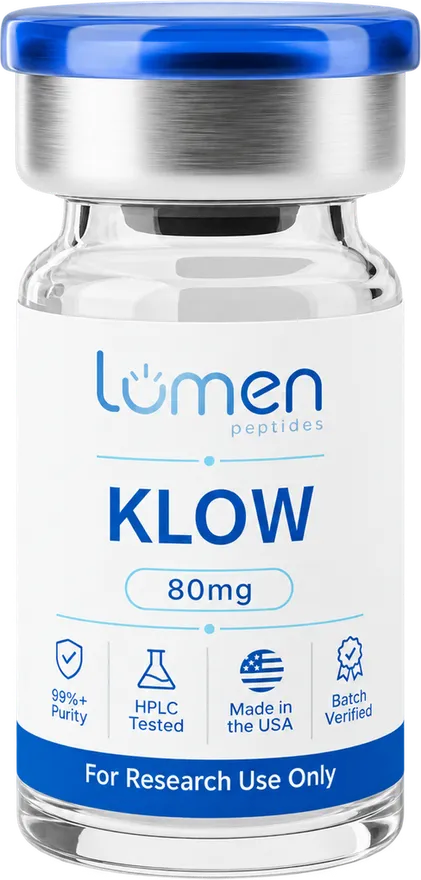
KLOW
- Components
- GHK-Cu · KPV · BPC-157 · TB-500
- Type
- Peptide blend
- Form
- Lyophilized powder
- Sizes
- 80mg

Research access
Lumen supplies research compounds to qualified researchers and laboratories for in-vitro use. Confirm once to enter.
By entering you affirm the statement above is true. Products are not for human or veterinary use, not for diagnostic procedures, and have not been evaluated by the FDA.
99.84%HPLC purity
Research Blends
Four-component repair & dermal research blend.
$120.0080mg vial
Buy 1, get 1 free: add a 2nd vial and it is free.
Researchers also added
Mix and match: Buy 1, get 1 free pairs any two vials in your cart. Research use only.
The compound
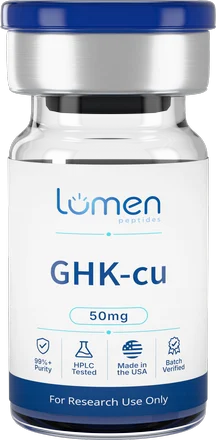
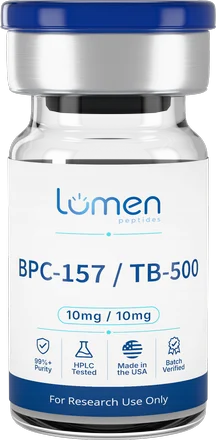
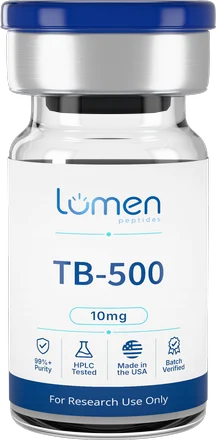
KLOW is a four-component research blend - GHK-Cu (50mg), KPV (10mg), BPC-157 (10mg) and TB-500 (10mg) - documented per component on its Certificate of Analysis. Research use only.
Specification sheet
Where it is studied
Combines cytoprotective, actin-regulating and dermal-signal components; see the COA for per-component documentation.
In the lab
In laboratory research GHK-Cu is studied for skin matrix remodeling, KPV for NF-kB signaling in gut cells, BPC-157 for vessel growth and TB-500 for cell migration. No paper has tested all four; a tendon repair study pairing BPC-157 and TB-500 saw no gain over either alone.
Compound
KLOWBlend of GHK-Cu, KPV, BPC-157 and TB-500Matrix remodeling
Endpoint studied
MMP-2 and TIMP releaseMore MMP-2, its mRNA, TIMP-1 and TIMP-2; copper ions alone matched the MMP-2 rise, GHK alone did not.Simeon 2000 · PMID 11045606 (opens PubMed in a new tab)Gut cell signaling
Endpoint studied
Lower cytokine secretionTaken up through PepT1; nanomolar KPV lowered NF-kB and MAP kinase activation and cytokine secretion.Dalmasso 2008 · PMID 18061177 (opens PubMed in a new tab)Vessel growth
Endpoint studied
New vessel formationHigher vessel density, more endothelial tube formation and faster blood-flow recovery.Hsieh 2017 · PMID 27847966 (opens PubMed in a new tab)Cell survival
Endpoint studied
Migration and survivalFormed a complex with PINCH and ILK that activated Akt; heart muscle cells migrated and survived more.Bock-Marquette 2004 · PMID 15565145 (opens PubMed in a new tab)Research history
5 milestones, each linked to its PubMed record.
1977
GHK-Cu
Experientia
The growth-modulating tripeptide found in serum is identified as glycyl-histidyl-lysine.
PubMed · PMID 858356 (opens in a new tab)1981
TB-500
Proceedings of the National Academy of Sciences of the United States of America
The 43-amino-acid sequence of thymosin beta 4, isolated from thymus, is determined; its N-terminus carries an acetyl group.
PubMed · PMID 6940133 (opens in a new tab)1984
KPV
Peptides
Lys-Pro-Val, alpha-MSH residues 11 to 13, lowers fever in a pyrogen model, though less potently than the full hormone.
PubMed · PMID 6333677 (opens in a new tab)1993
BPC-157
Journal of Physiology, Paris
A protective peptide isolated from human gastric juice is reported, with BPC 157, the 15-amino-acid fragment thought to carry its activity.
PubMed · PMID 8298609 (opens in a new tab)2026
BPC-157 + TB-500
Joint Diseases and Related Surgery
A tendon repair model tested BPC-157 plus TB-500: the pair improved tendon structure but added nothing over either peptide alone.
PubMed · PMID 42542926 (opens in a new tab)Laboratory research only, cited for research context. Not a claim about use in people.
Catalog peptides are specified at 99%+ identity purity. Each lot is verified by an independent laboratory using HPLC and mass spectrometry, and the results are published in that lot's Certificate of Analysis.
A COA is the lab document issued for a specific production lot. It records the compound's identity confirmation, measured purity and the lot number, so the vial on the bench can be traced back to its test results.
Orders placed before the daily cutoff ship the same or next business day from a US facility. Lyophilized peptides are stable in transit and do not require cold shipping.
L-H2O is a sterile, USP-grade laboratory solvent containing 0.9% benzyl alcohol. It is a bench accessory, not a peptide, and carries no HPLC purity claim or COA.
Research use only. Sold strictly for in-vitro laboratory research by qualified professionals. Not for human or veterinary use, not for diagnostic or therapeutic procedures, and not evaluated by the FDA.