Specification sheet
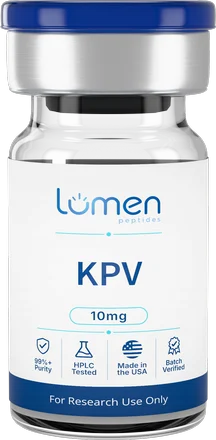
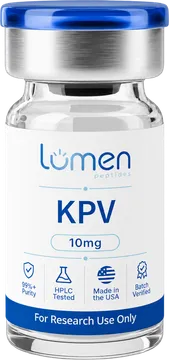
KPV
- Molecular weight
- 342.4g/mol
- Formula
- C16H30N4O4
- CAS number
- 67727-97-3
Sequence 3 residues
- Type
- Synthetic peptide
- Form
- Lyophilized powder
- Sizes
- 10mg

Research access
Lumen supplies research compounds to qualified researchers and laboratories for in-vitro use. Confirm once to enter.
By entering you affirm the statement above is true. Products are not for human or veterinary use, not for diagnostic procedures, and have not been evaluated by the FDA.
99.21%HPLC purity
Cytoprotection Research
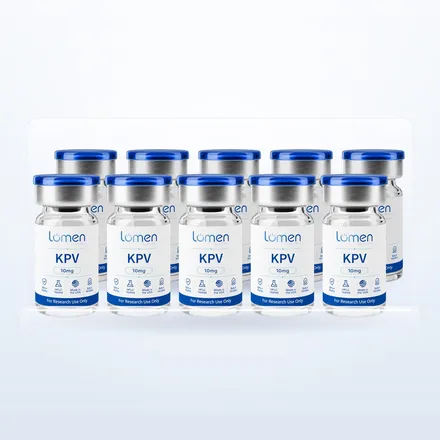
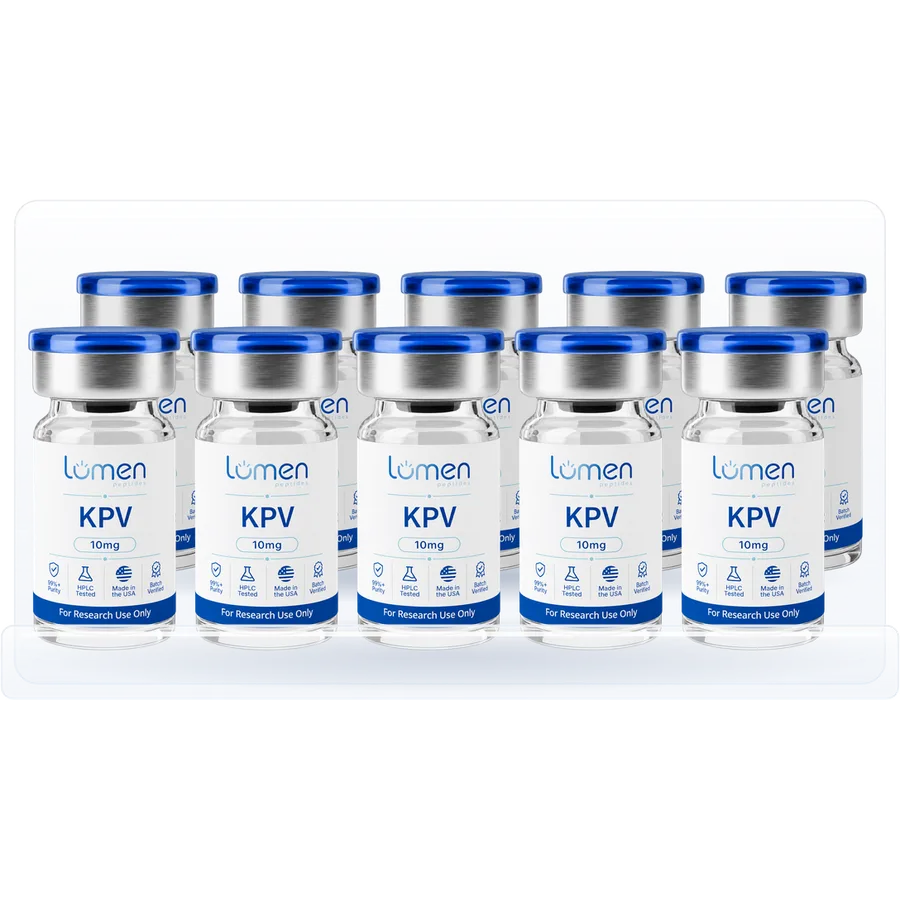
Ten KPV vials in one case.
$220.0010 × 10mg vials
Ten vials in one case, $22.00 per vial.
Researchers also added
Mix and match: Buy 1, get 1 free pairs any two vials in your cart. Research use only.
The compound
KPV is the C-terminal tripeptide of α-MSH, studied in anti-inflammatory and mucosal-repair research models. Research use only.
Specification sheet
Sequence 3 residues
Where it is studied
Investigated for down-modulation of pro-inflammatory NF-κB signaling in cellular models.
Explored in gut and epithelial inflammation-repair endpoints.
In the lab
KPV is the C-terminal Lys-Pro-Val end of alpha-MSH, and its receptor is not settled: it raised calcium in MC1R cells but acted outside melanocortin receptors elsewhere. In gut cells it enters via the PepT1 transporter and lowers NF-kB signaling.
Compound
KPVLys-Pro-Val, residues 11 to 13 of alpha-MSHIntestinal epithelial cells
Endpoint studied
Lower cytokine secretionTaken up through PepT1; nanomolar KPV lowered NF-kB and MAP kinase activation and cytokine secretion.Dalmasso 2008 · PMID 18061177 (opens PubMed in a new tab)Keratinocytes
Endpoint studied
Intracellular calcium riseNo cAMP rise; intracellular calcium rose in keratinocytes and in cells engineered to express MC1R.Elliott 2004 · PMID 15102092 (opens PubMed in a new tab)Corneal epithelium
Endpoint studied
Re-epithelializationWounds closed faster; a NO synthase inhibitor blocked this, and cultured corneal cells were more viable.Bonfiglio 2006 · PMID 16965771 (opens PubMed in a new tab)Research history
5 milestones, each linked to its PubMed record.
1984
Peptides
Lys-Pro-Val, alpha-MSH residues 11 to 13, lowers fever in a pyrogen model, though less potently than the full hormone.
PubMed · PMID 6333677 (opens in a new tab)1989
FASEB Journal
The C-terminal tripeptide alpha-MSH [11-13] reduces swelling in a contact inflammation model.
PubMed · PMID 2550304 (opens in a new tab)2003
The Journal of Pharmacology and Experimental Therapeutics
KPV cuts leukocyte influx without raising cAMP, and the effect appears not to run through melanocortin receptors.
PubMed · PMID 12750433 (opens in a new tab)2004
The Journal of Investigative Dermatology
In keratinocytes KPV raises intracellular calcium without a cAMP rise; MC1R-expressing cells respond the same way.
PubMed · PMID 15102092 (opens in a new tab)2008
Gastroenterology
KPV enters intestinal epithelial and immune cells through PepT1 and lowers NF-kB and MAP kinase signaling.
PubMed · PMID 18061177 (opens in a new tab)Laboratory research only, cited for research context. Not a claim about use in people.
Catalog peptides are specified at 99%+ identity purity. Each lot is verified by an independent laboratory using HPLC and mass spectrometry, and the results are published in that lot's Certificate of Analysis.
A COA is the lab document issued for a specific production lot. It records the compound's identity confirmation, measured purity and the lot number, so the vial on the bench can be traced back to its test results.
Orders placed before the daily cutoff ship the same or next business day from a US facility. Lyophilized peptides are stable in transit and do not require cold shipping.
L-H2O is a sterile, USP-grade laboratory solvent containing 0.9% benzyl alcohol. It is a bench accessory, not a peptide, and carries no HPLC purity claim or COA.
Research use only. Sold strictly for in-vitro laboratory research by qualified professionals. Not for human or veterinary use, not for diagnostic or therapeutic procedures, and not evaluated by the FDA.